-
Fully Connected Layer
- Put the outputs from the same layer into a vector $\vec{a^{l}}=[a^{l}_{1},a^{l}_{2},\cdots,a^{l}_{n}]$ . Neuro between every layer is fully connected,which means every nodes was connecter with each other one to one and contain a 权重 $w^{l}_{ij}$ (means eage from node j to node i). Those weight can creat a matrix: $$W^{l}=\begin{bmatrix}w_{11}^{l} &w_{12}^{l} & \cdots\\w_{21}^{l} &w_{22}^l \\ \vdots & & \ddots\end{bmatrix}$$i is row,j is col. W is a $N_{l-1}\times N_{l}$ matrix. Every layer has its own bias $b_{i}^{l}$ .And they form a new vector $\vec{b^{l}}$ .We have a eqaution: $$z_{i}^{l}=\sum_{j=1}^{N_{l-1}}w_{ij}^{l}a_{j}^{l}+b_{i}^{l}$$
- and when it comes to
awe put the resultzinto a function $\sigma$ (usually $\sigma$ meanssigmoid) and we use matrix to 表示 this equation $$\boldsymbol{A}^{l}=\sigma(\boldsymbol{W}^{l}\boldsymbol{A}^{l}+\boldsymbol{B}^{l})$$
-
Recurrent Structure
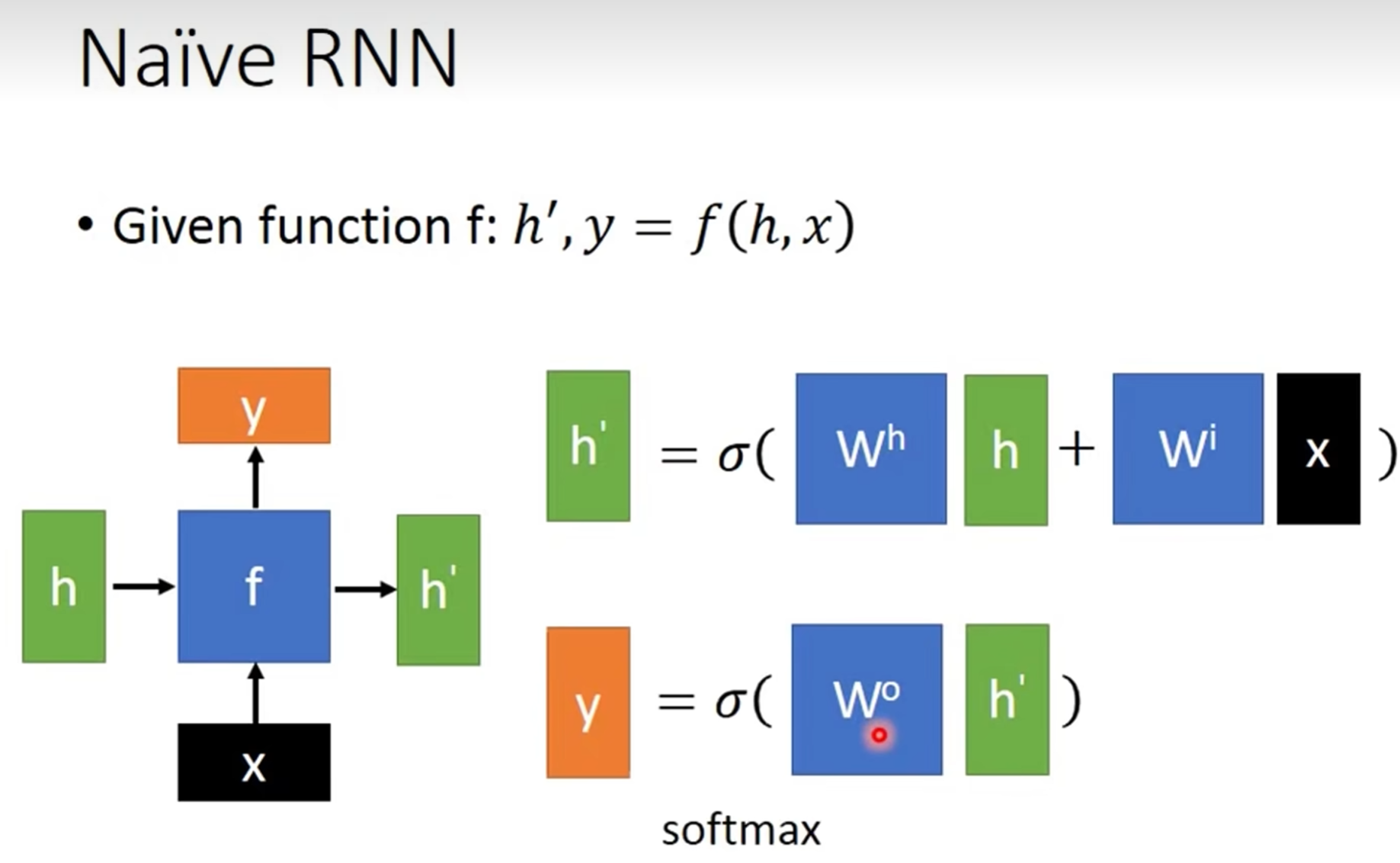
- give a function $f:h',y=f(h,x)$ . like what shows below.
his a series of vector with the same dimension.it will pass by some imformation to the next step. that means RNN performs well in solving sequence to sequence problem like language process.-
flowchart LR
    h0["h⁰"] --> f1["f"]
    x1["x¹"] --> f1
    f1 --> y1["y¹"]
    f1 --> h1["h¹"]

    h1 --> f2["f"]
    x2["x²"] --> f2
    f2 --> y2["y²"]
    f2 --> h2["h²"]

    h2 --> f3["f"]
    x3["x³"] --> f3
    f3 --> y3["y³"]
    f3 --> h3["h³"]

    h3 --> more["……"]

    classDef hState fill:#6FA84A,stroke:#6FA84A,color:#FFFFFF
    classDef fn fill:#3D6FB4,stroke:#3D6FB4,color:#FFFFFF
    classDef out fill:#E08A3C,stroke:#E08A3C,color:#FFFFFF
    classDef inp fill:#111111,stroke:#111111,color:#FFFFFF
    classDef cont fill:none,stroke-width:0px,color:#000000

    class h0,h1,h2,h3 hState
    class f1,f2,f3 fn
    class y1,y2,y3 out
    class x1,x2,x3 inp
    class more cont

    linkStyle default stroke-width:2px,stroke:#000000
-
- give a function $f:h',y=f(h,x)$ . like what shows below.
-
Deep RNN
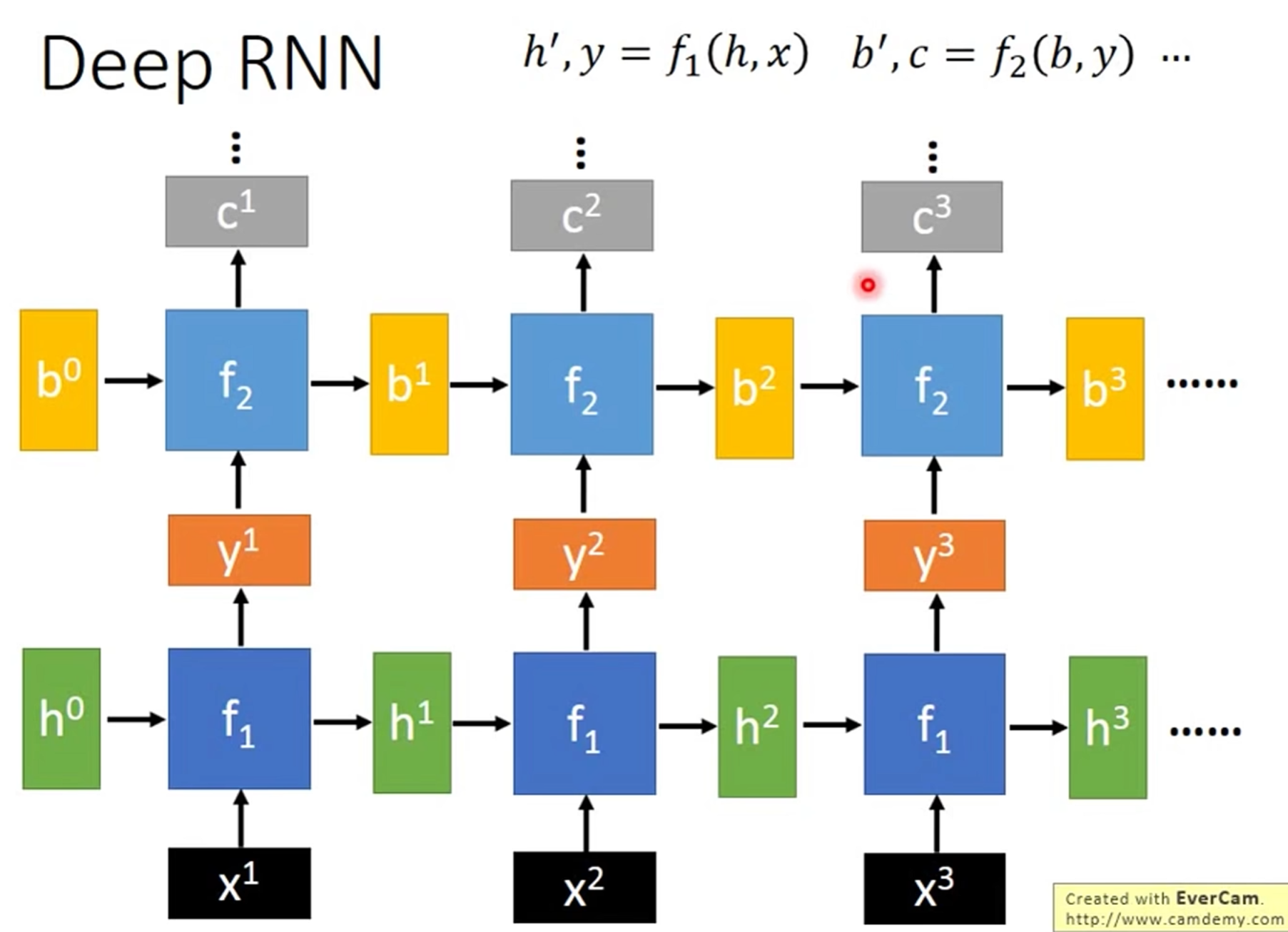
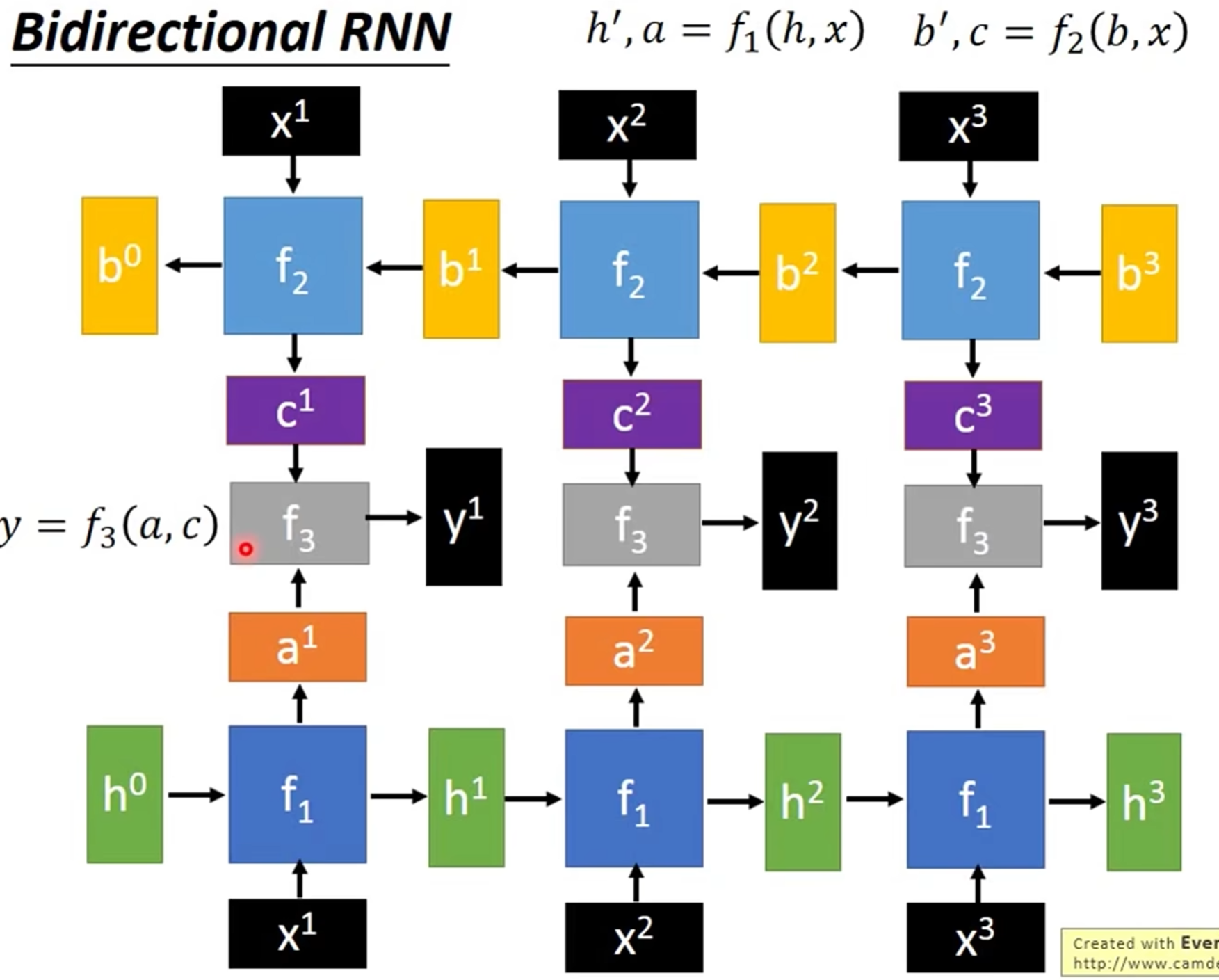
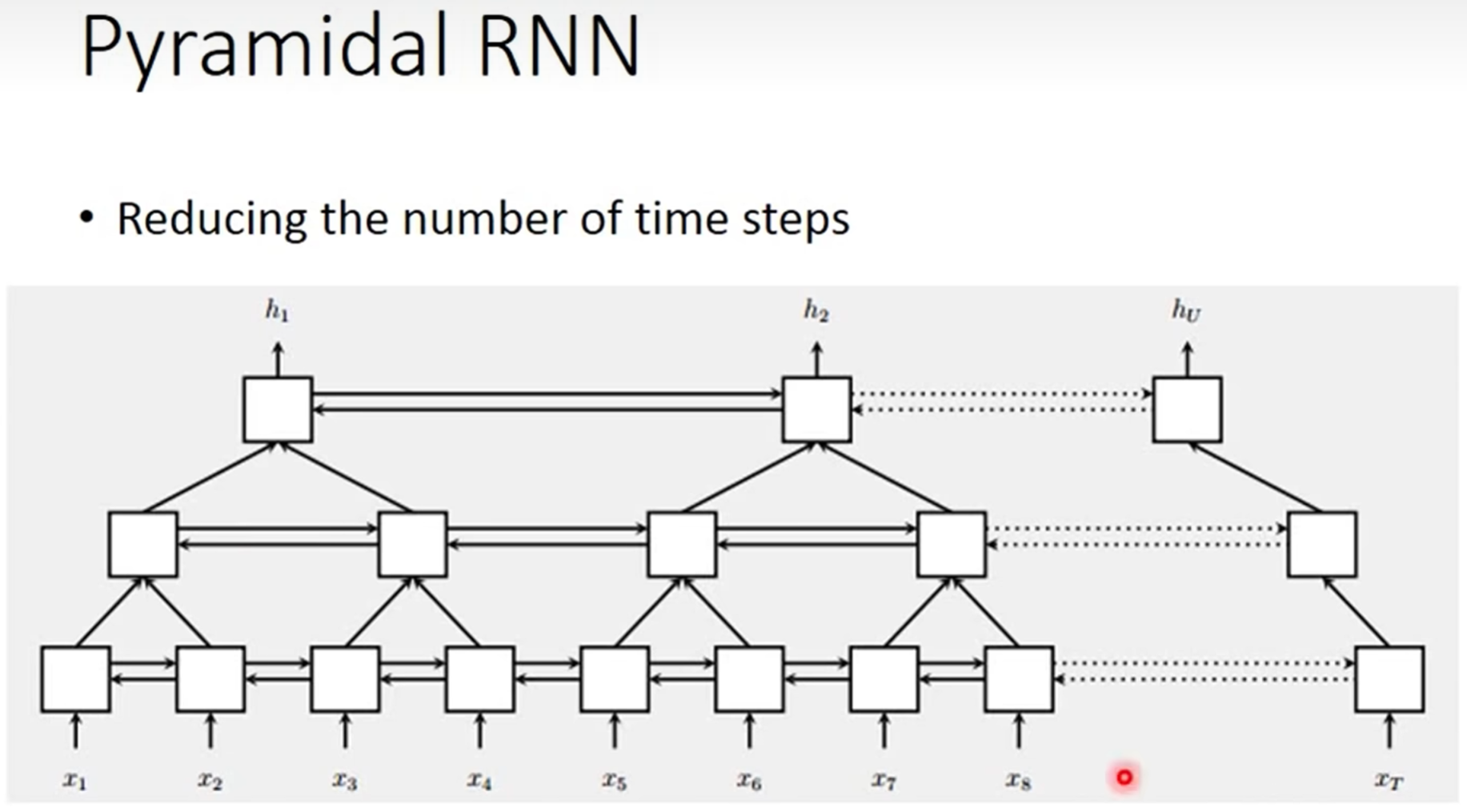
- W. Chan, N. Jaitly, Q. Le and O. Vinyals, “Listen, attend and spell: A neural network for large vocabulary conversational speech recognition,” ICASSP, 2016
- longer sequence mean unparalled input leads to longer training time
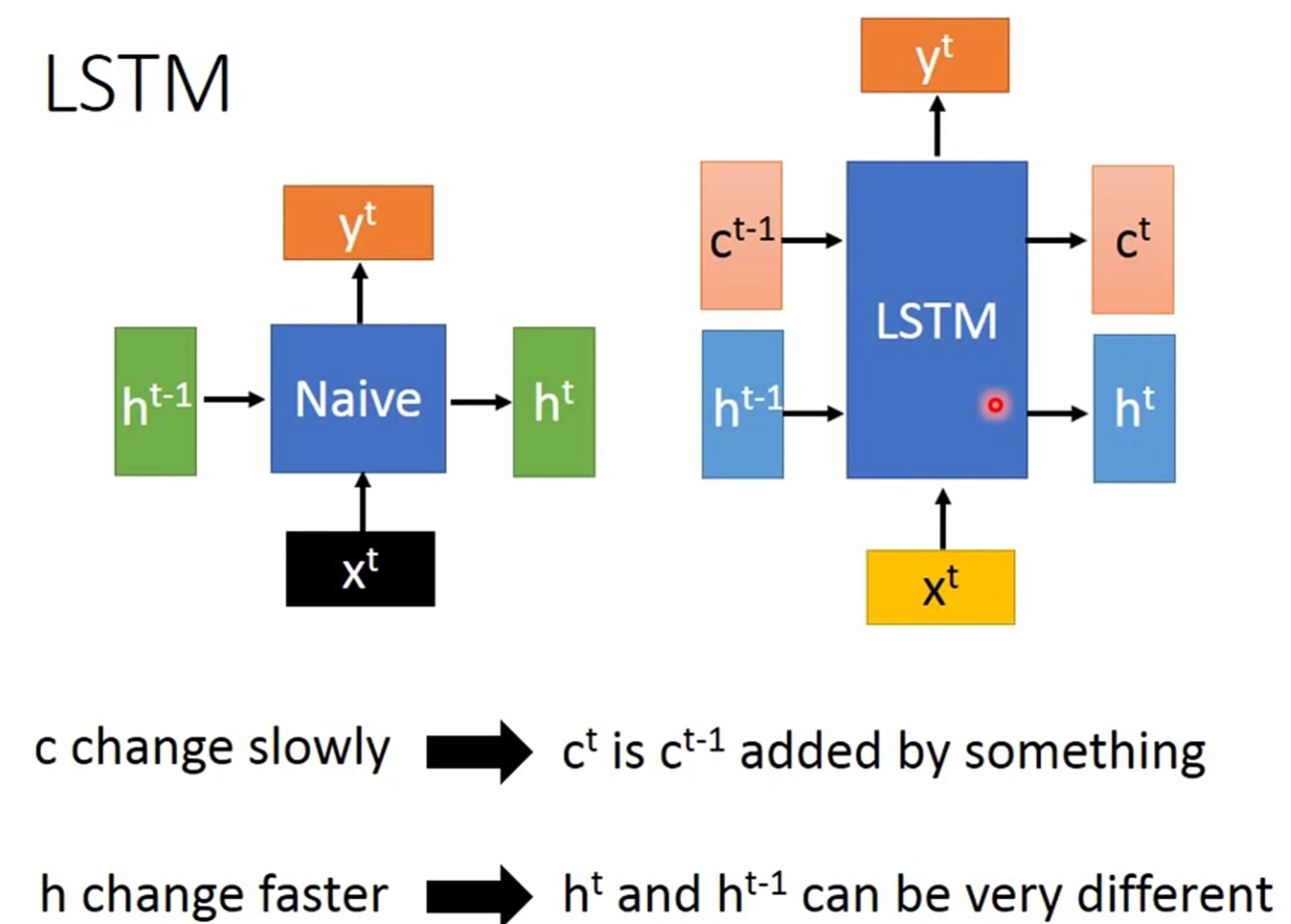
-
LSTM
- why c and h cannot combine
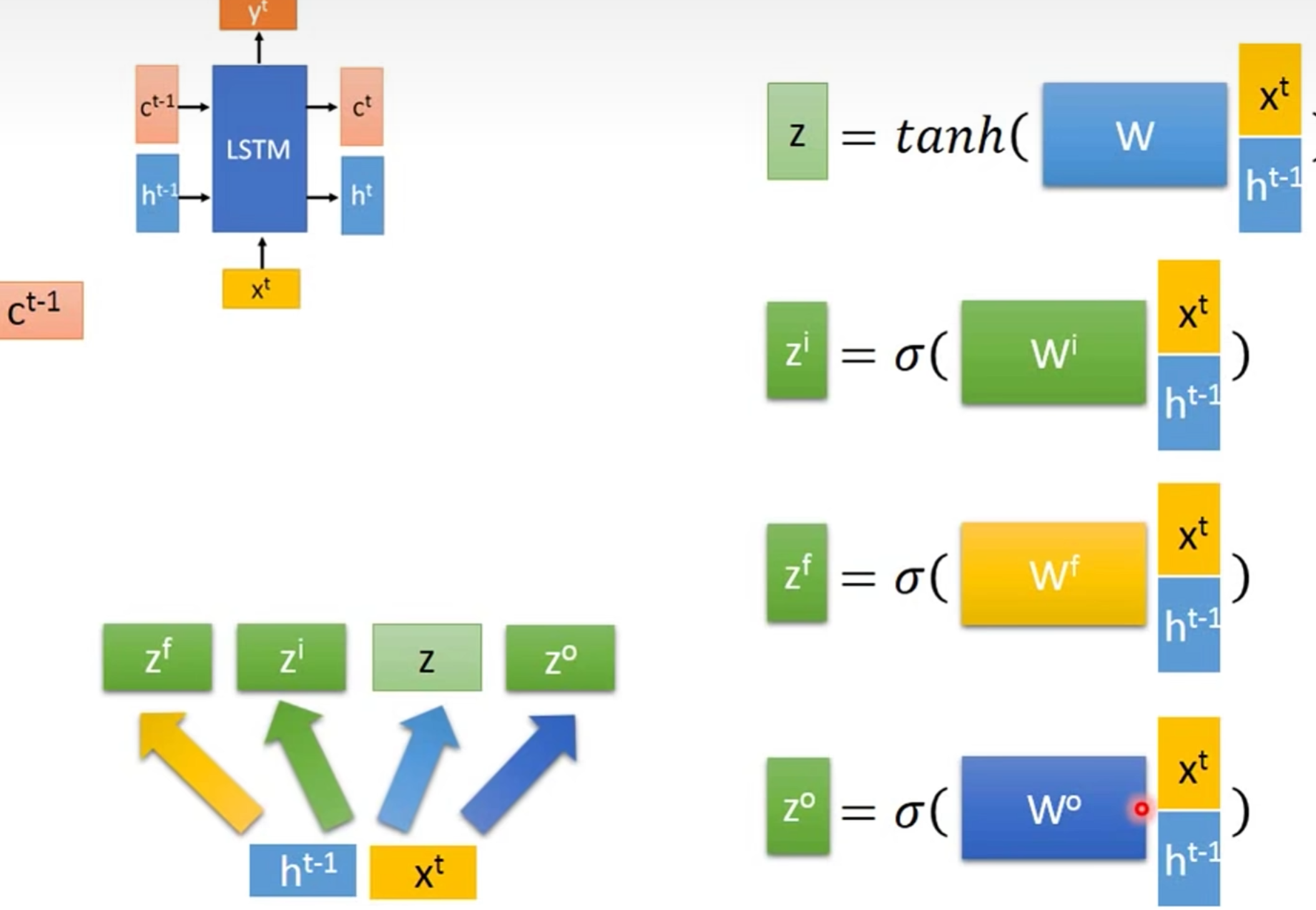
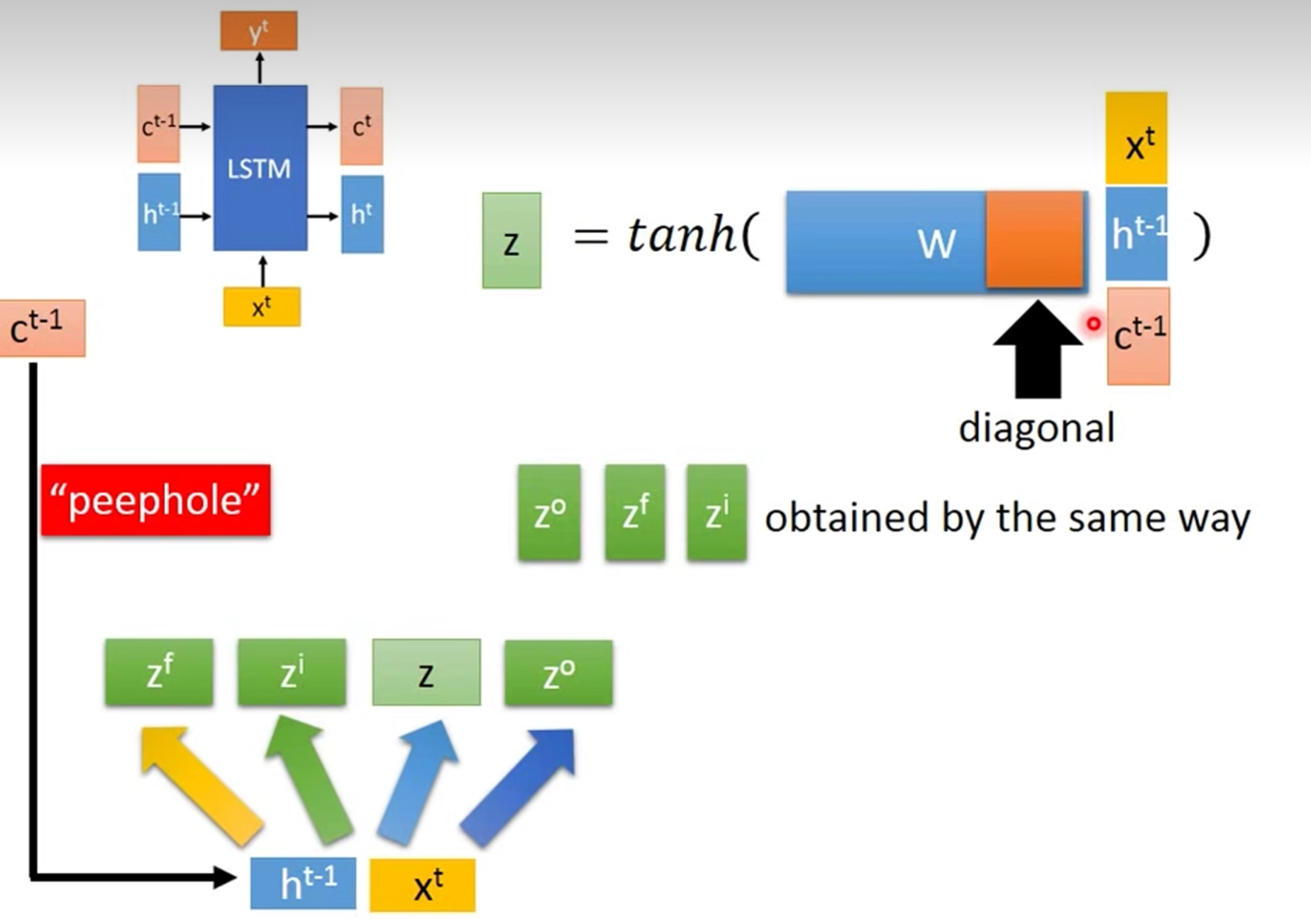
- diagonal
- input gate; forget gate; output gate;
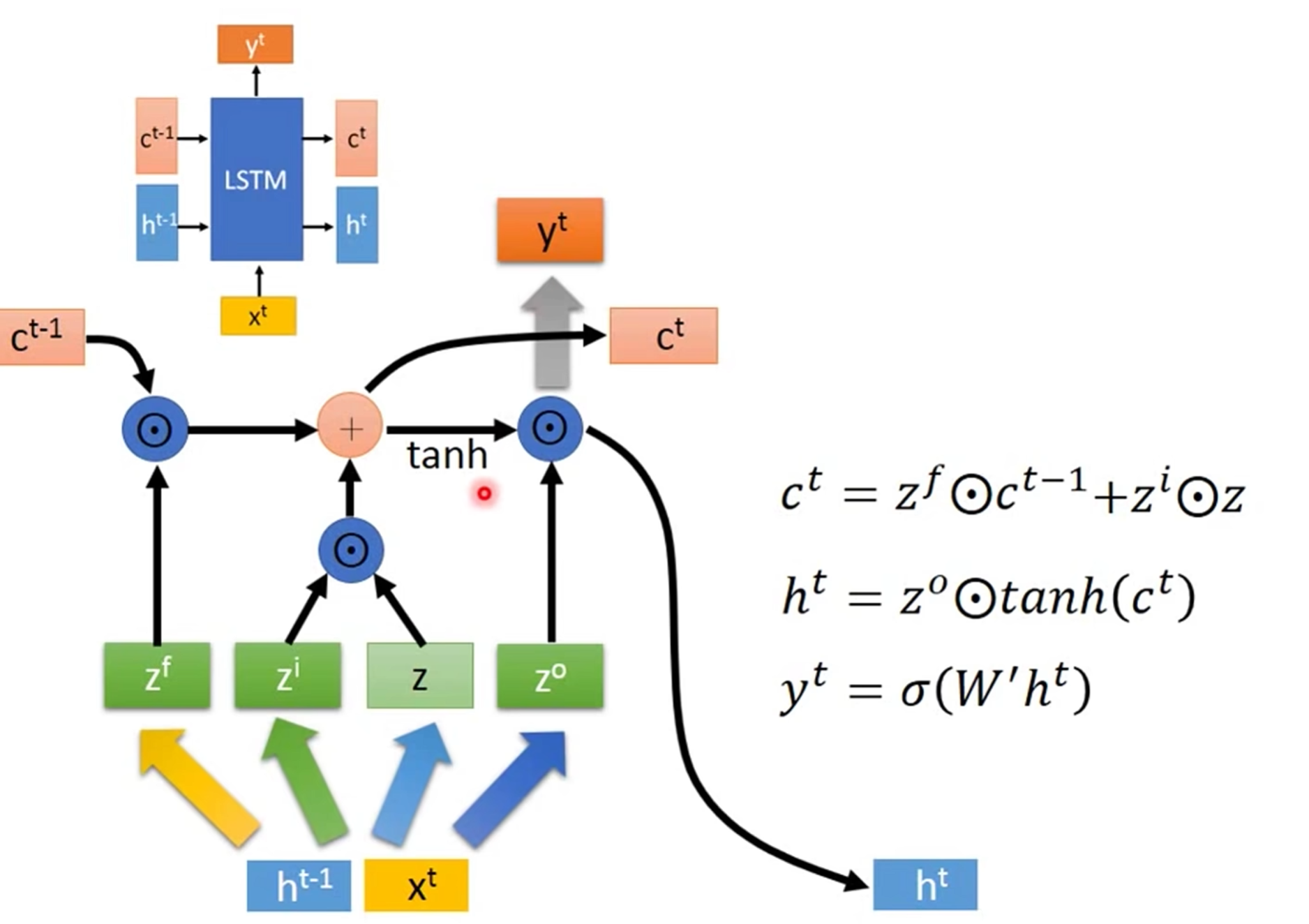
-
GRU
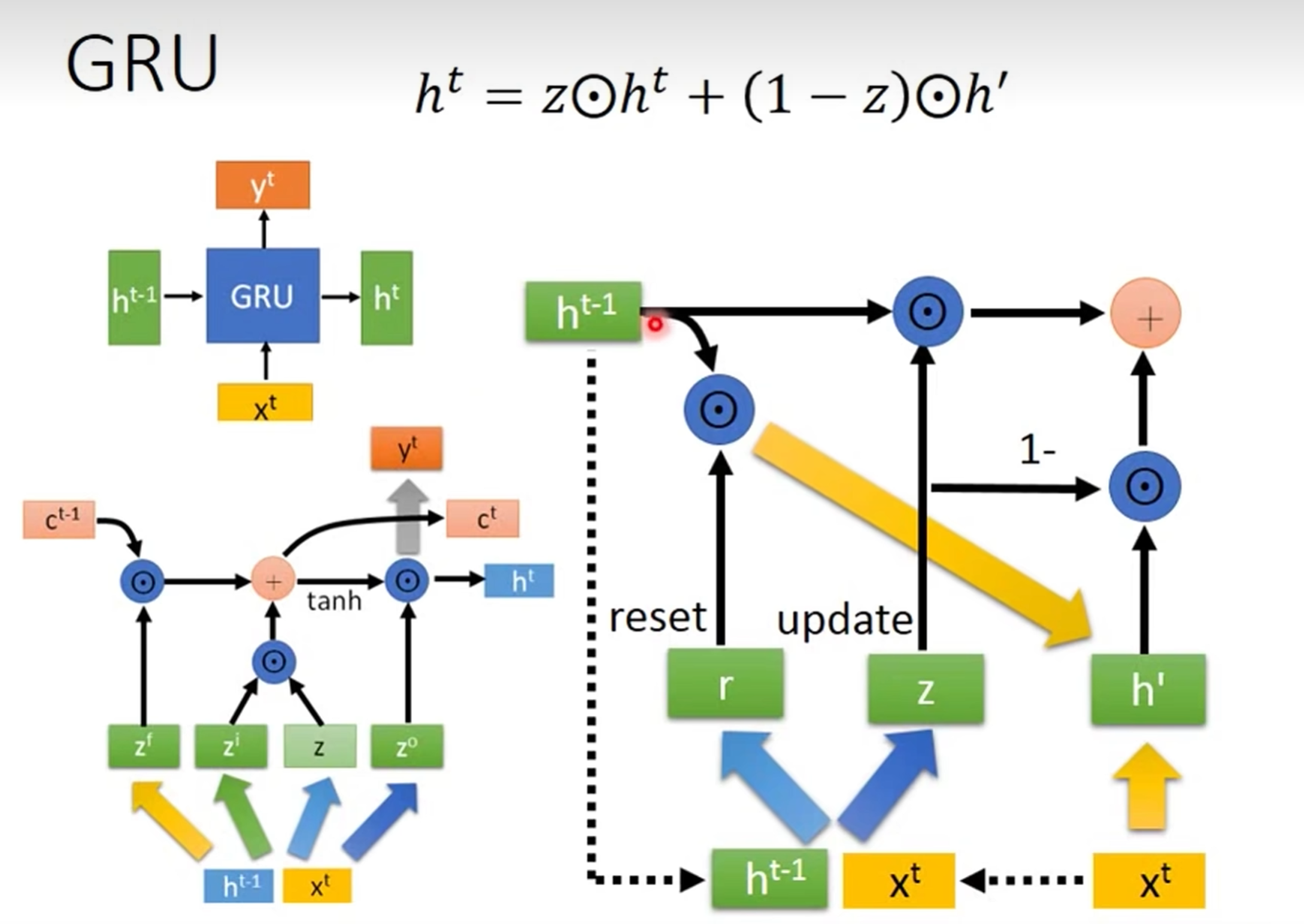
- error: $h^{t-1}$ instead of $h^{t}$
- only three matrixs
-
Task
- TIMIT
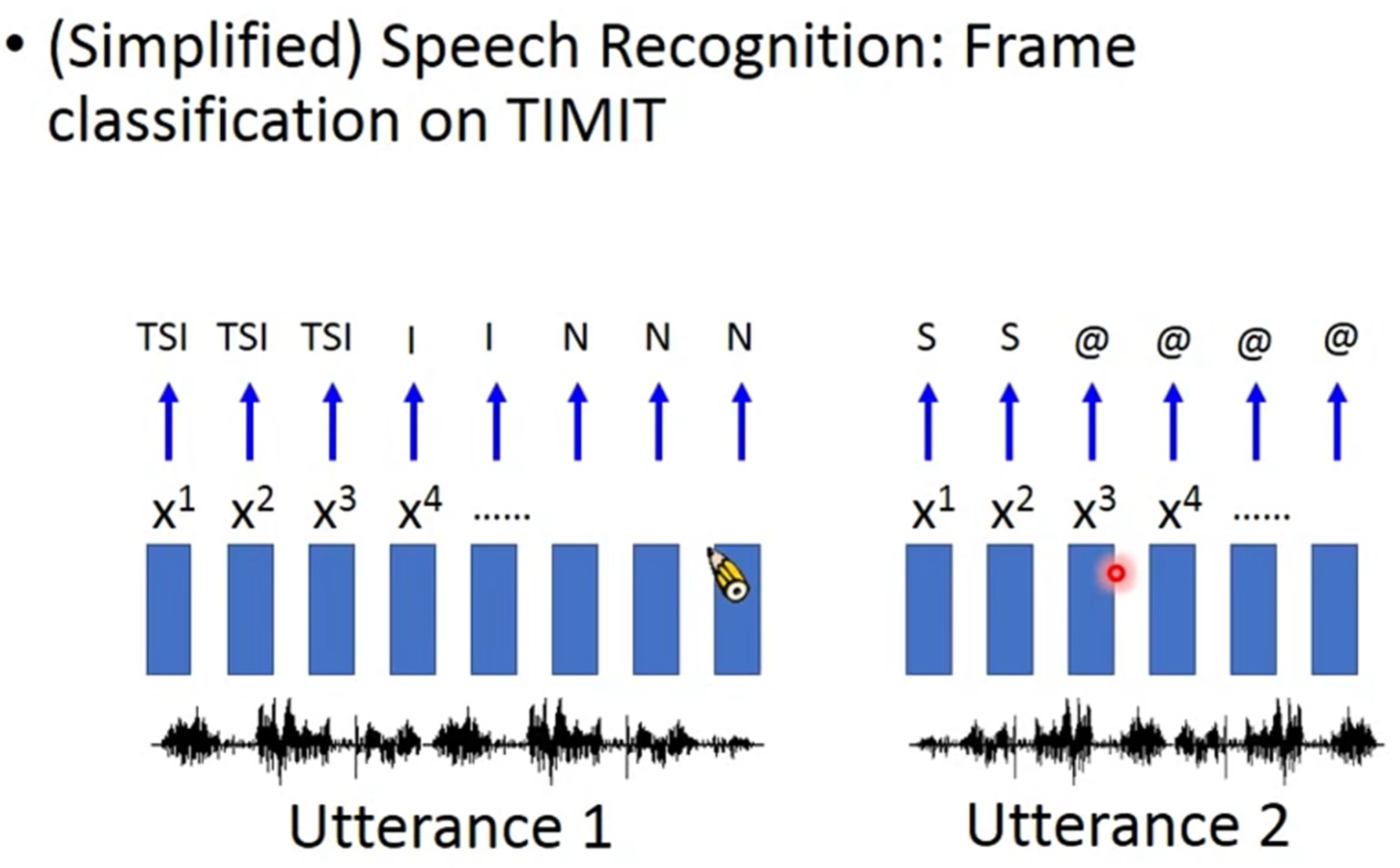 音标
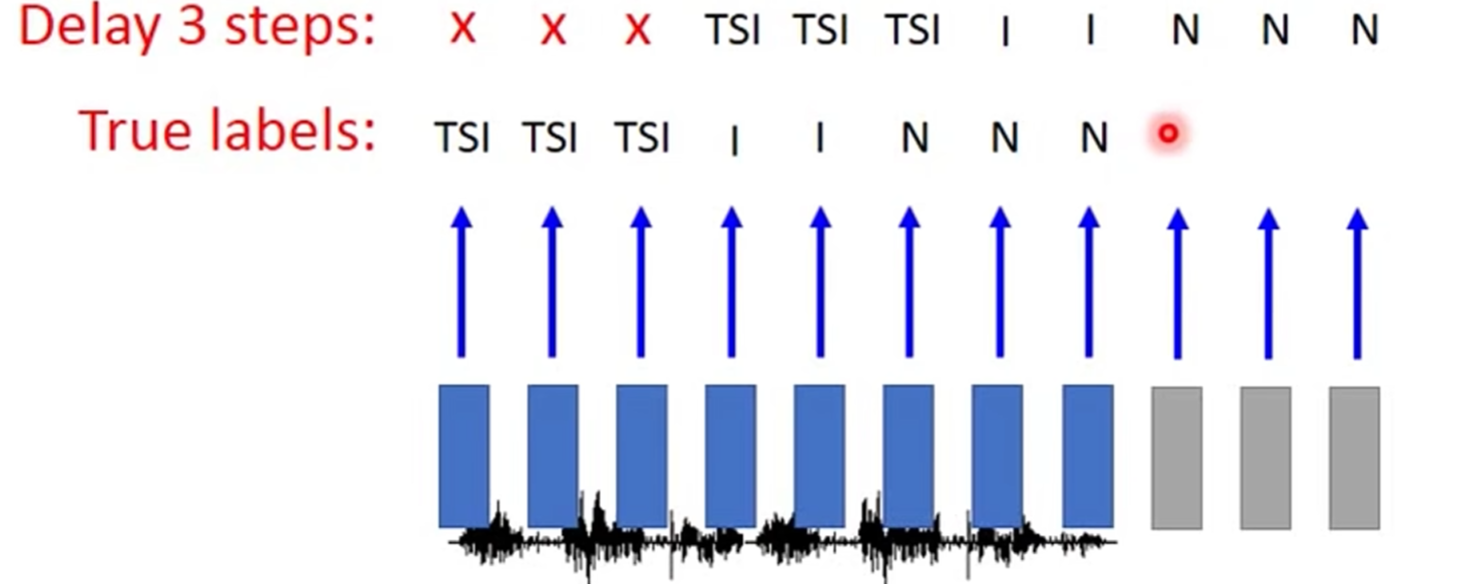
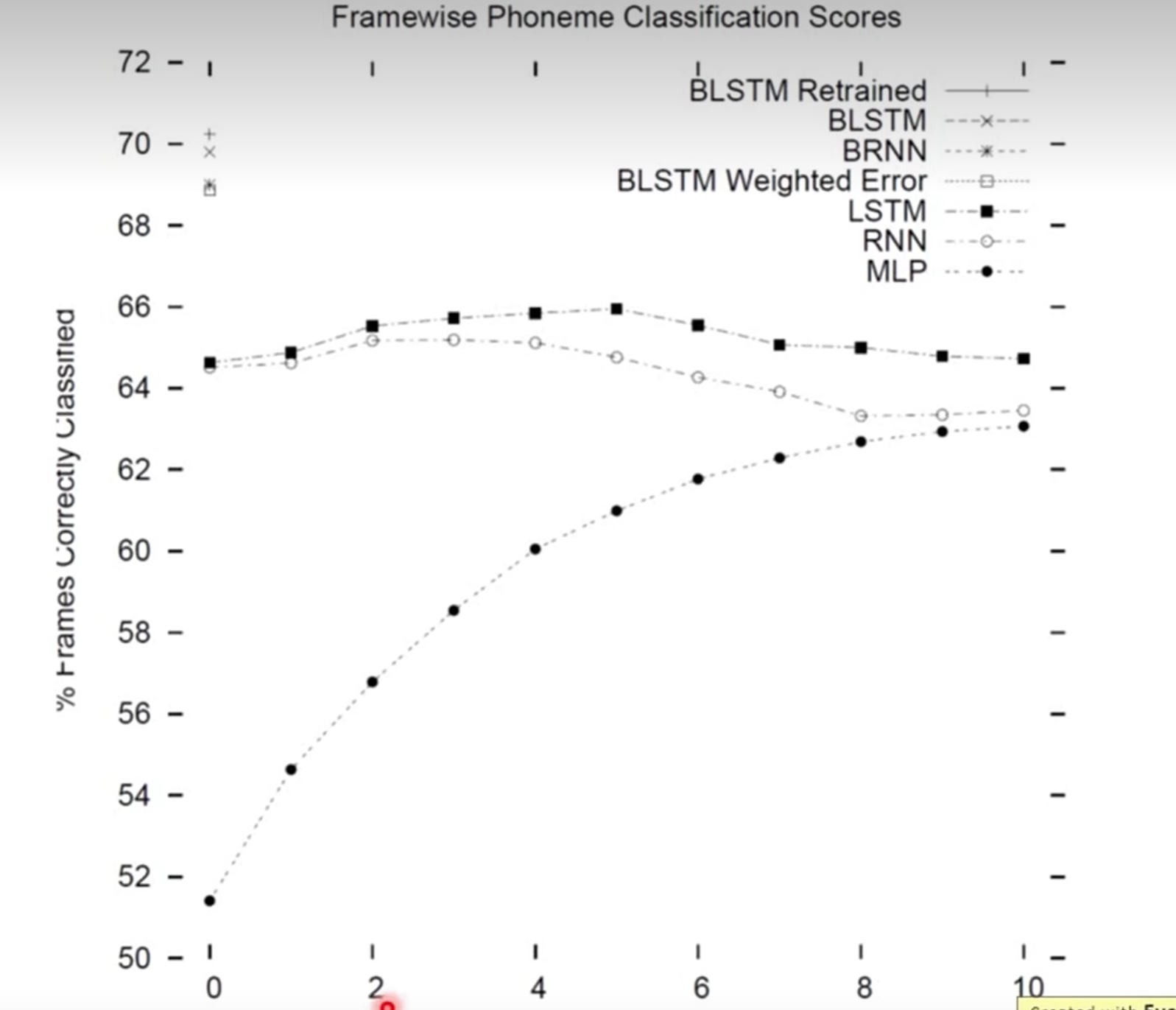
- the advantage of delay, for the rection of machine
-
Stack RNN
- pick front element and put into a function, and restore the result into a stack
-
convolutional layer
- sparse connectivity: like skin neuron
- kernal/filter
- Example:
- 1D + single channel
- one-dimension + multiple channel
- 2D + single channel
- 2D + multiple channel
- padding
-
pooling layer
- group
1~k(ornk+1~2k) outputs together, choose a presentation(average pooling, Max pooling, L2 pooling)
- group
-
maxout Network
-
Not grouped because they detect the same pattern — grouped so that they can detect the same pattern.